Blog

FIDIC Contracts & Claim Avoidance: The PM's Vital Role in Dispute Prevention
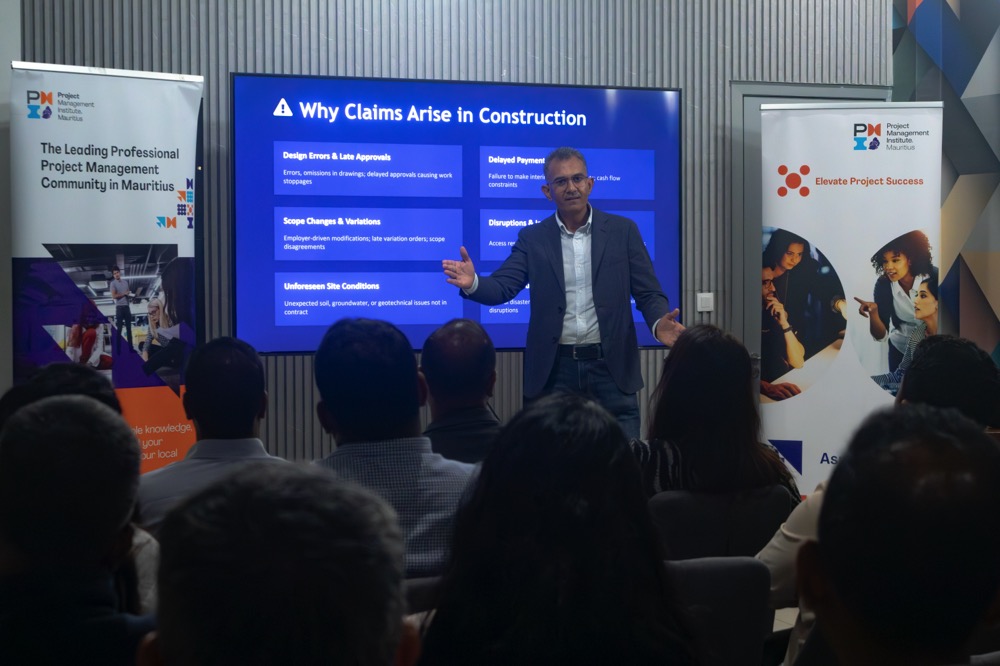
The PMI Mauritius Chapter kicked off its new Construction sector seminar series this week with a strong turnout of 30+ attendees at the Club House, Royal Green Wellness Resort in Réduit. The evening, hosted from 18h30 to 20h00, was opened by Nathraj Chadee, our Construction Ambassador, who set the stage for what proved to be a practically grounded and a locally relevant session.
Our guest speaker was Mr. Mohammad Yassin Doolaur — Structural Engineer, Chartered Building Engineer, International Professional Mediator, Registered Professional Engineer of Mauritius (RPEM), and Vice Chair of the FIDIC Membership Committee. With over two decades of experience on landmark projects including the New Airport Terminal in Mauritius and the B&S Tower at Ebene Cybercity, Yassin brought to the room the rare combination of technical, managerial, and legal perspective that FIDIC discussions demand.
Why FIDIC, and why now
Yassin opened by reminding the audience that construction projects are inherently complex undertakings — multiple stakeholders, significant financial exposure, technical uncertainty. When disagreements escalate into formal disputes, the consequences are familiar to every project manager in the room: delays, ballooning costs, and damaged professional relationships.
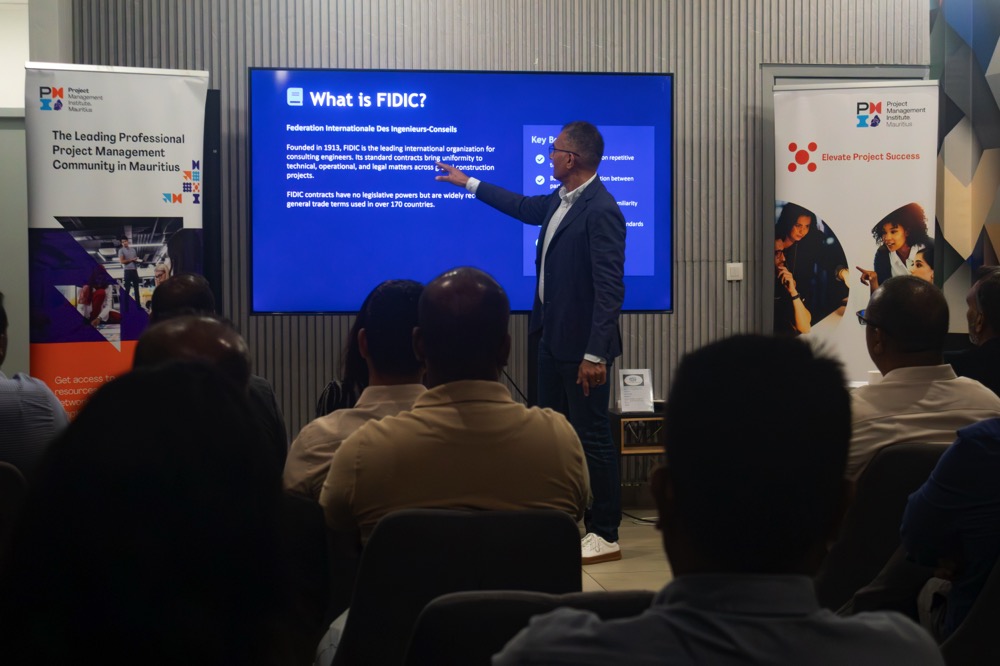
FIDIC contracts, published by the Fédération Internationale Des Ingénieurs-Conseils since 1913, are used in over 170 countries precisely because they offer a balanced, internationally recognised framework for managing those risks. Yassin walked through the Rainbow Suite — Red Book (Construction, employer-designed), Yellow Book (Plant & Design-Build), and Silver Book (EPC/Turnkey) — showing how each shifts the risk allocation between Employer and Contractor. He also gave a quick overview of the FIDIC Golden Principles, the foundational guardrails that any compliant FIDIC contract should honour, regardless of how heavily the particular conditions are amended.
When Fadhil asked about the Gold Book, Yassin acknowledged the relevance — the Gold Book covers Design, Build and Operate works typical of water treatment plants and dams, which is exactly Fadhil's sector. In practice, however, the pure Gold Book is rarely used; a hybrid Gold/Yellow approach is more common, and in Mauritius the Gold Book is rarely seen at all.
The 2017 shift: from resolution to avoidance
A recurring theme of the talk was the philosophical shift introduced by the FIDIC 2017 edition. Where 1999 was structured around resolving disputes once they arose, 2017 makes avoidance the primary mandate. Both parties — not just the Contractor — now follow the same claims procedure, the detailed claim window has been extended from 42 to 84 days, and a standing Dispute Avoidance/Adjudication Board (DAAB) is now mandatory rather than optional. Yassin shared a real-world reference of a DAAB convened for a USD 350 million airport project, illustrating just how serious the international market is about embedding avoidance at the contractual level.
Yassin also drew attention to the 28-day time bar under Sub-Clauses 20.1 and 20.2.1, where even a valid claim can fail entirely if notice is not served within 28 days of the Contractor becoming aware of the event. The numbers in FIDIC, he reminded us, are never arbitrary — and here he made a point that drew nods around the room: clients often take their contracts to lawyers for review and come back with seemingly innocent tweaks to the prescribed timeframes, not realising those periods are there for good reason and tie in with other deadlines in the contract. But lawyers don't always understand construction, and the 56-day periods in the Red Book exist for very specific, calculated reasons. Edit them without that context, and the contract's internal logic starts to unravel.
The Mauritius reality check — and the force majeure debate
The most animated part of the evening was the discussion around how FIDIC's avoidance philosophy lands in the local context. Despite DAAB being central to the 2017 edition, the common practice in Mauritius is to strike DAAB out of contracts as "not applicable." In some contracts, even mediation clauses are removed. The practical consequence: almost every serious dispute in Mauritius eventually ends up before the courts — exactly the outcome FIDIC is designed to avoid.
The conversation then opened up around force majeure, with Dhiraj raising a question that resonated immediately across the room. Despite repeated and significant fuel price hikes that have rippled through supply chains over recent years, force majeure has not been declared on those events. The discussion underscored just how narrow the contractual definition of force majeure really is — and how easily project managers can be caught out assuming that "exceptional market conditions" will entitle them to relief when, contractually, they will not.
The Project Manager as frontline
For our PMI audience, the centrepiece of the talk was the Project Manager's role. Yassin framed the PM as the first line of defence against claims escalating into disputes — through contract administration, advance warnings under Sub-Clause 8.4, monthly joint review meetings, rigorous documentation, and proactive variation management under Clause 13. "No work without written instruction" was repeated more than once.
He brought these principles to life with real-world claim and dispute scenarios, including a Rotterdam tank terminal project where a €5M global claim collapsed for lack of particularised evidence, and a 2024 Kenyan judgment where an Employer lost summary judgment for missing the Notice of Dissatisfaction and arbitration windows. Both reinforced the same lesson — contemporary records and procedural discipline are the PM's best weapons.
Key takeaways
- FIDIC 2017 makes dispute avoidance the mandate, not the afterthought
- In Mauritius, however, DAAB and mediation are often struck out — and disputes end up in court
- Force majeure is narrowly defined; market events like fuel price hikes typically do not qualify
- The numbers in FIDIC contracts (56 days, 28 days, 84 days) are calculated, not arbitrary — amend them carefully
- A standing DAAB, engaged early, can resolve the majority of issues before they crystallise into disputes
- Contemporary documentation is the foundation of both defending and prosecuting claims
We extend our sincere thanks to Yassin for sharing his expertise with such generosity, and to every member who joined us at Royal Green. This was the first in a planned series of in-person and virtual seminars dedicated to the Construction sector.

Special thanks to Nathraj Chadee and the team of volunteers for planning and organising this event.
About the author

FIDIC Contracts & Claim Avoidance
Highlights from our first Construction sector meetup at Royal Green Wellness Resort, Réduit. Guest speaker Mr. Mohammad Yassin Doolaur — Vice Chair of the FIDIC Membership Committee — shared two decades of insight on FIDIC contracts, the Project Manager's role in claim avoidance, and the local realities of dispute resolution in Mauritius.
/